
I don’t find that I spend my free time like most other people. Sure, broadly speaking I play vidya games and read books and watch videos like any other young person. But if you’ve seen my previous articles, my taste might seem like a total random mumbo-jumbo that don’t seem to follow any patterns other than being weird, unknown, and indie. I’ve tried to connect a theme together for years, but even the common theme of niche-ness doesn’t fully explain my fascinations. But recently, I think I’ve found the central thesis behind my interactions with media, which is that I like media that is built to put me into a flow state.
If you’re wondering what I’m referring to with flow state, it’s often cheesily referred to as being “in the zone” – a state where a person is wholeheartedly focusing and enjoying a task such that it almost becomes the only part of their consciousness. This is not to be confused with hyperfocus or hyperfixation, in which the focus leads to a detrimental effect on the person or the quality of execution of the task at hand. In a sense, the article’s title is kind of inaccurate, since an addiction would be more of a hyperfixation than a true achievement of flow.

And before you call me a dopamine-addicted zoomer – I wouldn’t say it’s quite like that. Being a flow addict doesn’t entail having short attention spans or scrolling social media feeds searching for the next thing. Neither is it being an adrenaline junkie – at least, not in the sense that I need to be in risky or dangerous situations.
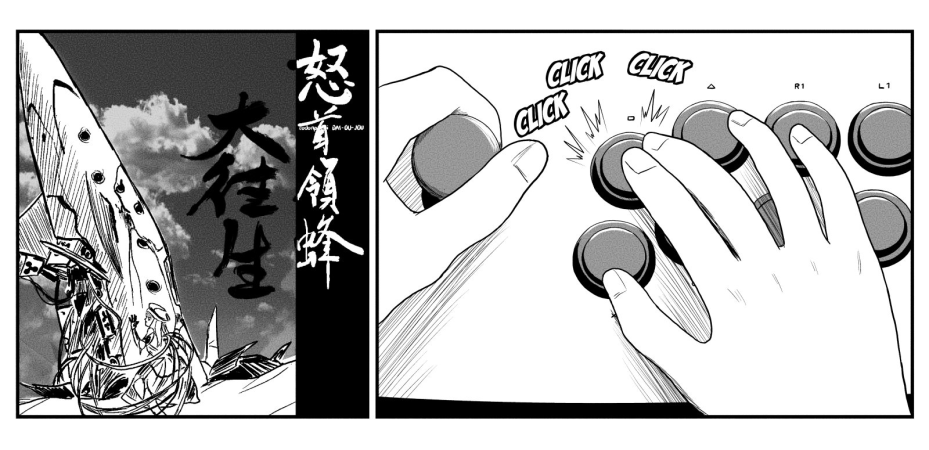
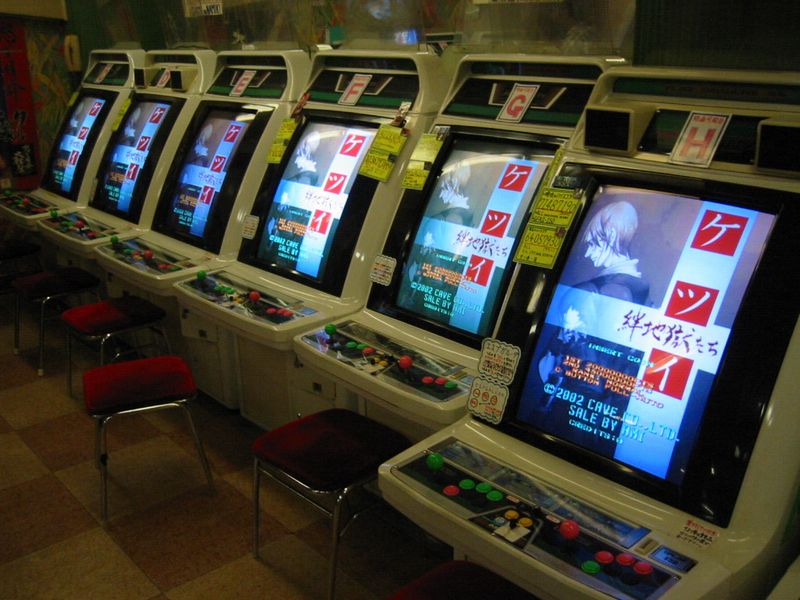
The most glaring example of my pursuit of flow is my involvement with arcade-style games. Arcades are a curious wonder – a showcase of pure flow in a public space, whether or not other people are there to witness it. Cyclical games with no save feature, where the goal is not simply to put enough hours in to progress to discover everything, but instead to hone and practice skills until the machine is your instrument and you are an artist.
For me, the most relevant games are rhythm games and shoot ‘em ups. It’s definitely primacy bias that I like these ones in particular, but they really do cook up a perfect storm – emphasizing full focus on performance, along with immersive sound and flashy graphics that also serve instant feedback on one’s performance. The process of practicing skills within these arcade games is also highly conducive to flow state, and in many ways mirrors developing real-life performance skills in music or theater or otherwise. I would even argue that the tools given to you make it more rewarding than those performances. These points equally apply to other arcade subgenres like fighting games or puzzle games (I mean, have you seen Tetris the Grand Master players?).
Somewhat regrettably, these preferences also include various competitive and “esport” games like League of Legends and Counter-Strike, which I have a long history of playing since middle school. These might be the only games I enjoy that would also be considered popular. Despite all the toxicity that might be present in these games, I still have a “good relationship” with them and to me they are a way to turn off my brain, which is kind of a different kind of flow state but still follows the same principles as before.
This is generally why I have always found it unbearably difficult to get into and enjoy the typical “open world” games that get so much critical acclaim from players. GTA, Elder Scrolls, Just Cause, Fallout, Bioshock, Far Cry, Cyberpunk 2077, The Witcher, Assassin’s Creed, the list goes on and on – these games are unfortunately actively disruptive to my flow. Obviously, these are not the only games that I don’t enjoy playing, just the most pertinent examples of an extremely popular genre. When I play those kinds of games, I just don’t really feel like I have a purpose. It’s not about improvement or imprinting skills into my brain – it’s more really just about progressing to whatever’s next, until the game inevitably has nothing more to give you. This is also why I respect speedrunning these kinds of games more than casual play – not because I am elitist or competitive, but that I believe that speedrunning turns these kinds of games into better facilitators of flow.
As a related side note, I believe that cutscenes that remove all control of your character never add any value to a game. They completely disrupt any semblance of flow – and in many ways, I also feel that they provide a very awkward and shoehorned method of storytelling that really makes me wonder why it isn’t just another form of media in the first place.

However, all this about video games and all the focus on pure gameplay doesn’t mean that I don’t know how to appreciate a good story. On the flipside, I believe that if I am to experience a story, it better be in a way that allows me to engage and interact with it across its full breadth, sometimes to the extent of constantly taking note of my thoughts and theories. Some scholars conceptualize this as “push media vs pull media”, which compares stories that are passively pushed onto people with stories that pull people in to actively engage with it.
This is why, in general, I love books and visual novels more than video-based media. I love when it is just me and the story, where I have control but I really don’t because of the inescapable force that renders me unable to acknowledge that anything else even exists in that exact moment. The important part is that nothing is there to take the control away from me, which helps me think, absorb, and theorize at my own smooth pace. I’ve already expressed in previous articles what an incredible journey it was for me to read Umineko no naku koro ni, as it was captivating, engaging, and pure, to the point where I filled entire notebooks with observations, thoughts, theories, all trying to make sense of what seemed like such an infinitely complex story.

This also isn’t to say that TV shows or movies are incapable of activating an engaging flow state. There are plenty of them out there, like Christopher Nolan’s Memento, that shove things in your face and challenge you to figure it out. It’s all a spectrum, and the only thing I’m saying is that in broad terms, TV and movies are more pushy than books or video games. Visual/fine art can basically be anywhere on this spectrum too, but I’m no expert in that. But also, no matter how push or pull the movie is, I’m the kind of guy who likes to keep talking and theorizing the whole time, which can be quite annoying to some people.
So yeah. I love being in a flow state, and my media habits reflect that. As for the reason behind that… who knows? It could be that I lacked getting into flow state from doing things like sports as a kid. It could be that it’s just primacy bias, that those types of media were exposed to me earlier than other things. Or maybe my brain really is just hyperactive or something. Whatever dumb reason it is, here I am and that’s that. Hopefully that sheds some light on what I do in my free time.

 The Vault Publication
I really enjoyed reading your blog post! It’s fascinating how you’ve discovered that you enjoy media that puts you into a flow state. I resonate with that feeling of being fully immersed in a task and experiencing that sense of focus and enjoyment. My logical question for you is, have you found any other types of media or activities outside of gaming and reading that also put you into a flow state?
Hey, thanks that you liked the article. The name above this comment might say “anonymous” but yes, I am the author.
I think humans have evolved to enter flow states with physical activity, of course – I’m not the more athletic person but I’ve found that long-distance swimming, running, and biking tend to do the trick; especially because the other senses are dulled, like how being underwater dampens sound or how I can listen to music that keeps my pace constant on the bike.
Many people would also say competitive sports put them in the zone but I’ve never been really into them. I’m not exactly a very competitive person to begin with.
Music also works for a lot of people. Nowadays I have a bit of a nervous complex over music performance but composition and improvising can be profoundly focusing. It’s just that often I need a really good idea to springboard off of or else I feel kind of aimless.
Thank you for your reply. I like to ride and swim with only my thoughts to keep me company. It’s amazing how much I can do when distracted by my internal dialogue.