
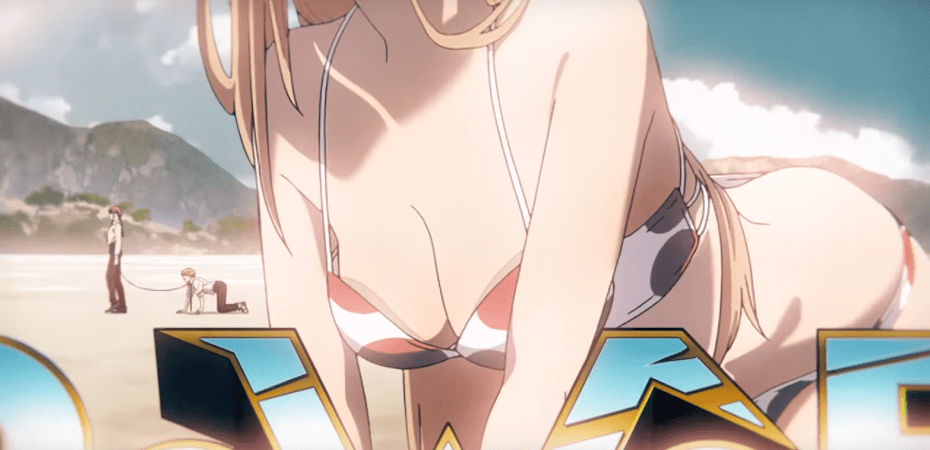
Look, I like Chainsaw Man. I love it, even. I read the manga in a single sitting and it took over my brain, I’ve talked about it nonstop for almost a year. I think Tatsuki Fujimoto’s art, paneling, and narrative style are some of the best in the business. I also think Chainsaw Man absolutely, unequivocally, sucks. It sucks because its objectification of women is literally inescapable. But nobody really talks about that part, which is what sucks even worse. So I’m here to put on my feminist killjoy hat and say, look, can we actually talk about Chainsaw Man’s problem with women?
It’s not all bad. Chainsaw Man has a lot of fantastic female characters, who are at least implied to be whole people; Power, Makima, Kobeni, and even Himeno are iconic for a reason. The problem is how it looks at them, and how it makes the audience a part of that looking.
The motivating force driving the plot of Chainsaw Man is that its protagonist Denji is horny. This in and of itself is not bad, surprisingly enough: there’s a strong case for a nuanced reading of the text in which Denji’s sexual motivations change over time as he learns that what he craves isn’t the sexual conquest he was taught to expect, but genuine connections with other people; that despite everything he’s heard about touching boobs and getting pussy, it feels empty if you don’t actually care about the person you’re with. The problem is that the camera’s motivation is the same as Denji’s. It’s really pronounced in the anime, the way the camera will take Denji’s POV, leering at Makima and Power and Himeno, the zoomed-in shots of boobs in the opening, the groping scenes with Power and Makima, the entirety of the 7th episode’s ending sequence. The camera itself is looking from Denji’s gaze; the camera is driven by sexual gratification. This makes the audience complicit, too: the character, the camera, and the audience all engaging in the act of looking at women as objects of sexual gratification. It is the textbook definition of the male gaze.

“Male gaze” can seem like a buzzword, but it was coined with a specific meaning. Feminist theorist Laura Mulvey in her seminal 1975 essay “Visual Pleasure and Narrative Cinema” called it “Woman as image, Man as bearer of the look,” which she described as the way that male is the active viewer and female becomes the passive viewed object. She writes: “The determining male gaze projects its fantasy onto the female figure, which is styled accordingly. In their traditional exhibitionist role women are simultaneously looked at and displayed, with their appearance coded for strong visual and erotic impact so that they can be said to connote to-be-looked-at-ness. Woman displayed as sexual object is the leitmotif of erotic spectacle: from pin-ups to strip-tease, from Ziegfeld to Busby Berkeley, she holds the look, and plays to and signifies male desire.” (Mulvey, 1975).
This dichotomy of looker/looked-at is created by the subjective gaze of the camera: the camera looks at women, creating a film in which women are looked-at, meaning the audience, male or female, has no choice but to assume the role of the looker, and for the women in the film to be perpetually looked-at, further cementing the assumption that women are things to be looked at, and men are the ones doing the looking. It’s a self-reproducing cycle that constantly re-objectifies women and re-empowers men. It’s a principle of film theory, but the implications of the male gaze go far beyond what is on the screen: it changes the way you think about yourself. It creates an internalized voyeur.
The male gaze in cinema, the constant looking at women, creates a situation in which women conceive of themselves as something to be looked at. Film theorist John Berger in “Ways of Seeing” described it as: “Men look at women. Women watch themselves being looked at. This determines not only most relations between men and women but also the relation of women to themselves. The surveyor of woman in herself is male: the surveyed is female. Thus she turns herself into an object of vision: a sight.” (Berger, 1990)
Margaret Atwood described this self-surveillance in a quote that has haunted me since high school, when I read it for the first time and had the roots of my constant anxiety about being seen fall into place. “Even pretending you aren’t catering to male fantasies is a male fantasy: pretending you’re unseen, pretending you have a life of your own, that you can wash your feet and comb your hair unconscious of the ever-present watcher peering through the keyhole, peering through the keyhole in your own head, if nowhere else. You are a woman with a man inside watching a woman. You are your own voyeur.” (Atwood, 1993)
It’s hard to explain this internalized objectification to someone who has not felt it, the ever-present awareness of how you look, the tendency to think of yourself from a third-person perspective, try to imagine how someone else would look at you, to view your body as an entity distinct from yourself. The crushing threat of ugliness, of failing to look good in front of the inescapable internal voyeur. And these constant constraints affect you directly. Objectification on such a societal level that you reproduce it in your own head; a direct impact of structural misogyny, reducing you to just a body.
All of this is, obviously, bigger than just Chainsaw Man. It’s not like Tatsuki Fujimoto and Mappa studios personally invented misogyny and the patriarchy. But they perpetuate it in very obvious ways, when they dedicate so much screen time to looking at every female character in the series. Anime and manga in general are dripping with misogyny, and the fact that “fanservice” is just something you have to put up with when watching almost any show kind of says it all. The looking is inescapable. And I can feel some of you rolling your eyes at me: What am I supposed to do about it? Never watch anime again? And that’s not the point I’m trying to make. I’m not “canceling” Chainsaw Man, I’m not saying enjoying it makes you a bad person. If I tried to cancel every piece of media that had something bad in it I would have basically nothing left to read or watch. I’m just saying we need to talk about it more.
It’s not a fun conversation. It sucks when things you like are bad in some way, and it’s understandable why people want to just avoid those aspects of them. But without serious criticism, what will improve? Feminist writer Sara Ahmed wrote an entire manifesto about the necessary dedication to being a killjoy: to criticize and to “ruin” and to be a total downer about misogyny because someone needs to talk about it. “If something would make us unhappy, when acknowledged, we need to acknowledge it.” (Ahmed, 2017) So, yes, Chainsaw Man has a serious problem with women, one that we should–and that I will–continue to talk about in the hopes that eventually, one day, I’ll be able to watch and anime and not have to think, wow, I sure wish she wasn’t represented like that. In the meantime I will be enjoying Part 2 of the manga and complaining about it feministly the whole time.
Works Cited
Ahmed, Sara. Living a Feminist Life. Duke University Press, 2017.
Atwood, Margaret. The Robber Bride. Doubleday, 1993.
Berger, John. Ways of Seeing. Penguin Books, 1990.
Mulvey, Laura. “Visual Pleasure and Narrative Cinema.” Feminist Film Theory: A Reader, edited by Sue Thornham, Edinburgh University Press, Edinburgh, 1999.

 The Vault Publication
FINALLY SOMEONE ELSE SEES IT. the misogynist part isn’t really even denji’s “need” to touch boobs. it’s that every female character is over sexualized and suited for male gaze. i also enjoyed the manga a lot but when i was talking to my friend who recommended it to me, he kept making excuses if i’d say it’s a little misogynistic. men, smh
Go read something written by a woman that was made for you, dumbass.
amazing reply, pickme
Go read something else, shit-for-brains.
you cannot look at asa mitaka and then say this
the whole point of chainsaw man is the over glorifying of sex to the point where a male being sexually assaulted, groomed, or even raped is severely undermined in society. the point of those oversexualizing scenes is to make you uncomfortable, as denji doesn’t actually crave sex but instead craves love and intimacy that he was never able to have, and since he has never experienced it, and is a 16 year old teenage boy with raging hormones, and the FIRST thing he saw on a mission that shows any form of intimacy was a bunch of porno magazines. So he starts out believing in the primal instinct that sex is all you need, but later on he becomes more humanized and we seem him go from wanting to have sex because makima has big boobs, to wanting a true relationship that is very intimate all the time due to his hypersexuality. If you can’t see that in Chainsaw Man, then I’m afraid to say you never saw the themes of the story at all.
I understand the interpretation you’re describing, and I agree that the story is intentionally uncomfortable and that Denji’s hypersexuality is meant to come from neglect, grooming, and a lack of real intimacy. I’m not confused about that theme.
My issue is that, regardless of intent, the anime still very deliberately frames its female characters in sexualized, objectifying ways and asks the audience to sit inside that gaze for extended periods of time. Even when women are given implied depth or agency, their bodies, framing, and narrative function are still filtered almost entirely through Denji’s desire and confusion. The show is doing the thing it claims to be critiquing, not just depicting it.
If the long-term goal is to “teach” Denji that women are real people and that sex isn’t the same as intimacy, that lesson may resonate with viewers who needed to learn it themselves. For me, it doesn’t. I don’t need to watch women be repeatedly sexualized and instrumentalized in order to arrive at a conclusion I never lacked in the first place. I also find it off-putting that this is treated as a profound or necessary coming-of-age lesson rather than a baseline expectation.
So this isn’t about missing the themes. It’s about deciding that this particular framing, perspective, and premise isn’t something I want to spend time with. I understand that it resonates with some people. I’m just not interested in pretending that means it should resonate with me, or that I need to like it in order to “get” it.
[…] Can we talk about Chainsaw Man’s problem with women? https://vc.bridgew.edu/cgi/viewcontent.cgi?article=1163&context=undergrad_rev Chainsaw Man and Women in Refrigerators […]
[…] for years and she’s introduced with a button that lets you point binoculars at her boobs. I’ve written about the objectification of women before, you know my thoughts on it, it’s pretty unavoidable in gamer/weeb circles and for […]
I see this is something that I thought the show did really well as the editing made it very obvious that this was what the main character was seeing and paying attention to while in scenes that he was not in, those things didn’t really happen because that’s just looking at it from his perspective. I think the show did an amazing job with the editing showing and not just telling that he was a horny guy whose main motivation was sexual.
Author’s argument is that the oversexualization itself in the anime, regardless of the POV of the character, was aggressive and it takes women out of the experience and contributes to the objectification of women. The fact that it was obvious that the POV’s from a horny character is irrelevant, especially since most shonnen have the same objectification of women bodies and it even has a term called “fan-service”.
[…] I’ve mentioned before that I’m a complicated Fujimoto stan. But aside from my feelings on the ever-present culture of misogyny in anime and manga, I think Tatsuki Fujimoto is one of the greatest mangaka I’ve ever read. And the way that Fire Punch hit me like a truck absolutely confirmed that. […]
Go read something else, shit-for-brains.
No shit CSM has the male gaze in it, it’s thematically about and a critique of the male gaze. You genuinely missed the point as much as dumbass men who are in it for the power fantasy. Genuinely incredible
Denji is 18 and technically a young male, literally every young male is mad freaky and has boob desires. Did you even go to high school?
dumbass article
Retarded fr
Yap asf
This guy needs to quit his yapping, his favorite anime is probably My Little Sister Can’t Be This Cute
no fucking way! that fuckin made me laugh! ggs, that made my day!
An intersectional Western activist moaning about anime women? I’m shocked.
Honestly, if you get so offended by Chainsaw Man and the like then just stick to watching Marvel / Disney / Star Wars shows, or those race-swapped fantasy shows on Amazon. No-one is forcing you to watch Japanese products that you find distasteful.
What is it that your kind like to say? !If you don’t like it, don’t watch it…”
I thought this was a great article! The Atwood quote similarly stuck me. However, as a man, I’m still left unconvinced after reading the end of the article. Generally, I wish there were specific examples of how Chainsaw Man contributes to the male gaze beyond what serves the themes of the story. At least, beyond such quotes like “But [Fujimoto and MAPPA] perpetuate [the male gaze] in very obvious ways, when they dedicate so much screen time to looking at every female character in the series.” This is where our disagreement comes in: I don’t agree that it’s so obvious from scenes beyond Denji’s POV. Now, one could argue that the onus is on me to investigate these feelings myself, an in response I would question why I read your argument if I were just going to convince myself.
Until then, I LOVE Chainsaw Man, I think it’s an unequivocally GOOD series, and am a RELATIVELY UNCONFLICTED Fujimoto stan (the twitter sister stuff was weird).
Your critique of CSM is adjacent to those who critiqued Lolita
Pure brainrot of an article.
you’re a fucking retard, kys.
bro I’m on your side but are we fr gang kys really ? Over a bad article.
A lot of the comments are missing this point. The author states the problem is not that sexual themes drive the core conflicts and message of the story. It’s that the execution, the way the camera leers and objectifies female bodies, is problematic and indicative of the “male gaze.”
I’d like to counter this though. I think having the camera embody Denji’s male gaze enhances the story, rather than detract from it. If the show was shot from a detached, third-person perspective, it would not demonstrate Denji’s character motivations and the story’s overall themes as effectively. Making the viewer complicit in Denji’s male gaze was a deliberate choice by Fujimoto, perhaps to force the audience to confront and challenge their own biased perspectives and “gazes.”
At the very least, unlike in other animes, the sexual imagery in Chainsaw Man is not merely fanservice, it serves a clear narrative purpose and grounds the show thematically. While the objectification of fictional female bodies in the show may be problematic, I do not see how it could be censored without undermining the show’s underlying message, something I wish the article would have explored further.
This was a nice read +1