
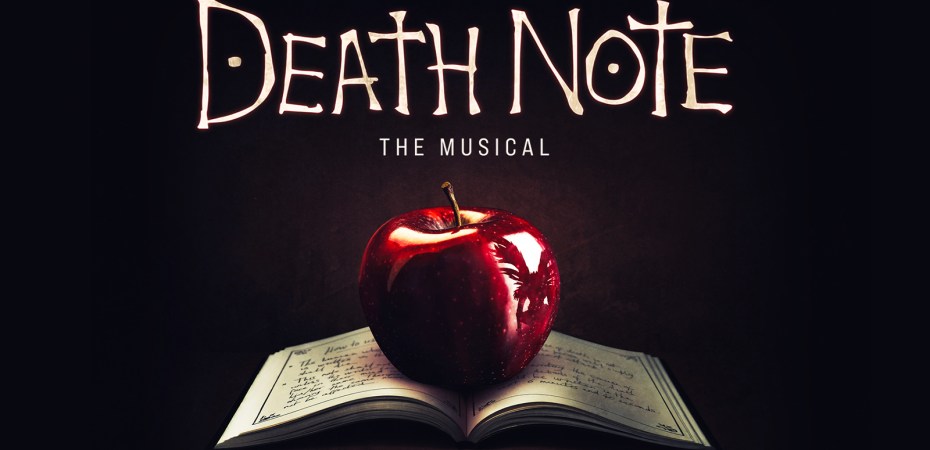

Spoiler Alert for Death Note and Death Note: The Musical
What makes a musical?
A musical is a combination of songs, spoken dialogue, acting, and dance. It tells a story but not just through visuals. Death Note: The Musical in Concert had its English premiere in London, England, which I attended.
London West End distinguishes full musicals from musicals “in concert”, which are basically the full version of their respective musicals but without as much attention to set design. This allows tickets to sell at a cheaper price (and is the reason I was able to afford to watch Death Note in the first place).
The main impact of musicals that sets them apart from other mediums like a movie is their ability to harness the emotional impact of music through sung words. It’s kind of like the happy medium for people who enjoy soundtracks in movies and people who find operas too boring. Conveying information through song also makes it easier to enjoy scenes over and over, as some songs are meant to get stuck in your head.
Moving onto Death Note.
What is Death Note and did the musical do a good job?
I am not too personally into the lore of Death Note, as I have only watched the anime. In fact, I only started binging it after I bought the tickets to the musical and had just finished the first arc right before I stepped on my flight to England.
Death Note is about a high school student, Light Yagami, who discovers a notebook that allows him to kill by writing someone’s name in it. He uses this power to kill criminals that he deems immoral and gains the alias “Kira”. His killings are noticed by the police force and an enigmatic detective L, who pieces together clues to find Kira’s identity. Due to the limitations of the musical format, it was understandably difficult to fit an entire series within 2 hours. The musical covers main events in the first arc of the anime, with a modified conclusion that makes Light die alongside L (a classic Shakespearean tragedy).
To someone who has not seen the series before, the pacing is quite fast. The morality of Death Note takes a while to get used to, and I imagine it would be difficult to follow both Light’s intentions and L’s detective work at the musical’s pace. However, the musical does make some intentions more unambiguous than the original, the specifics of which I will elaborate on further in the song-by-song analysis. Overall, in terms of accessibility to a general audience, there are elements that are universal enough to be enjoyed but definitely plot details that a first-time watcher would miss.
Set and costume design
The set immediately struck me as something similar to a postmodern play. The backdrop is covered in nonsensical writing, the stage is enveloped in a combination of darkness and red, and the sharp, straight edges of the walls almost reflect a constant internal turmoil. Although there are no set changes, Death Note’s one and only set serves all the purposes that it needs to. It includes Light’s bedroom, L’s chair, and the police office. Even the walls were put to good use, as the mirror-looking decorations lit up to show new broadcasts. A limitation of this static set design is that scenes that take place outside these three settings can be confusing for a first-time audience, such as the train scene where Light makes Haley Belle (the musical’s alternative of Raye Penber) write down the names of the FBI agents and then kills him.
In terms of costume design, the stars would probably be Ryuk and Rem. In the original series, the shinigamis were only in the background. However, in the musical, their elaborate costumes make their presence known. This is a clever choice for a musical, where the fourth wall is constantly being broken. The other characters can’t see them, but we sure can, and boy did the audience love it whenever they showed up. L and Light’s costumes followed the original. Misa’s was changed, as she was portrayed as a pop star in the musical. This was a puzzling choice to me and took some time to get used to, but I understand how it could have helped drive the musical plot – being a pop star would make her naturally get more songs.

This picture includes a light-up news broadcast screen (the orange rectangle on the left), which disguises itself as a regular mirror-like decoration. Features (left to right): Light, Ryuk, and Soichiro (Light’s dad).
Song-by-song brief analysis
Where is the Justice?
Is killing people wrong if they have done wrong? This song makes it more explicit compared to the original. Also a lot more Western cultural references, e.g. justice of large corporations and their rules. Cool intro.
They’re Only Human
A made-up conversation between Ryuk and Rem. Humans are just…human. This song makes use of the staircase on the set very well. Foreshadowing a “thing called love”. A great example of why musicals thrive on a non-existent fourth wall and soliloquies.
Hurricane
I really like the timbre of this for some reason. The chorus got stuck in my head the first time and stuck for a long time. The title and symbolism are a bit unoriginal though (with a couple more musical songs titled “Hurricane” *ahem* Hamilton).
Kira!
More shinigami shenanigans. Funny how it’s the shinigamis this time that solidifies the concept of “Kira”, rather than the masses. “Kira” doesn’t become a real thing unless you yell it a billion times – which is true in the real world, too. Ryuk’s view of Kira isn’t explored in the original. However, the concept of human-watching feels repetitive here.
I’m Ready
Very pop love song. Misa is just a pop star, nothing to see here.
We All Need a Hero
This song made me feel uncomfortable because of Sayu’s seemingly unconditional devotion to her brother. In the original, their dynamic is not shown beyond the fact that Light helps Sayu with her homework. It’s meant to establish the irony between Sayu’s “hero” and Light’s “heroism”. However, I felt that the morality of Light’s intentions has not been truly explored up to this point in order for the audience to understand that irony. The result just sounds like a Disney princess song, which is cool but makes me go like, noooooo Sayu…
The Game Begins
Introduction to L. This song makes L sound so robotic though. He’s still human, and what kind of human would describe themselves as a computer? A bit of a stretch.
There Are Lines
A very interesting premise that was not explored in the original. Was L’s usage of Lind L. Taylor in order to gain a clue immoral? Was a line crossed? Soichiro says “you don’t kill a man just to buy a clue”. I like Light’s part here though, it shows how much more manipulative he is, that he uses his father’s lessons to let him join the police force.
Secrets & Lies
Introduction to the L and Light counterpoint, as both want to use their brains to win. I love some good counterpoint melodies.
Mortals & Fools
Rem tells Misa how fake love is. I highly appreciate how this song finally introduces some female bonding. I want to say this finally makes the musical pass the Bechdel test unlike the original but technically not…since they’re still talking about Light, indirectly.

Misa and Rem.
Stalemate
L shows some of his deduction results, and suspects Light. This is after L tells Light that he is L. “I wonder if this guy’s for real” – Light
I’ll Only Love You More
Very pop love song, but more heartfelt. Misa clearly directs this to Light and shows him clues.
Honor Bound
The traditional Japanese song that shows Soichiro’s traditional values. He sincerely hopes that Light is not Kira and emphasizes Light’s duty to his family. One of my favourite wordplays from the musical: “But if what I’m seeing bends as Light reflects?”
Playing His Game
L and Light try to be each other to play each other’s game. Their voices become basically indistinguishable. “Does he see pixels, not dreams?” – Light (arguably a bit disrespectful to my poor L)
Borrowed Time
Misa sings while blindfolded. “Betray him” is all I remembered from her belting it out while tied to a dolly.
When Love Comes
Cryfest. It’s a miracle to make me so invested in Rem and Misa’s relationship within two songs, but this musical did it.
The Way It Ends
Why does this sound so happy when L is literally about to die? The original episode when L dies is one of the most iconic episodes in the anime. It’s filled with biblical references and an air of non-final finality. Determinism? How much of L’s actions are still his own? The musical makes L no longer in control of his own life up until his death.
Requiem
A classic musical requiem to end a tragedy.
Overall, go watch the musical if you can. Maybe when it comes out on YouTube as a slime tutorial or something if you don’t want to travel all the way to London. Hopefully, it comes somewhere closer.

 The Vault Publication