
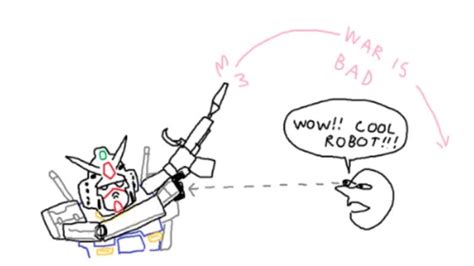
Mobile Suit Gundam as a franchise is firstly about big robots being cool, and secondly about the horrors of war; a thematic dichotomy famous enough to be the subject of a meme. But the way wars are fought has changed pretty drastically since the franchise started in 1979, and comparing the conflict in the World War II-inspired Mobile Suit Gundam (1979) to the depictions of terrorism in Mobile Suit Gundam: The Witch from Mercury (2022) shows two very different conceptions of conflict and its motives, a disparity that reflects the changing reality of war.
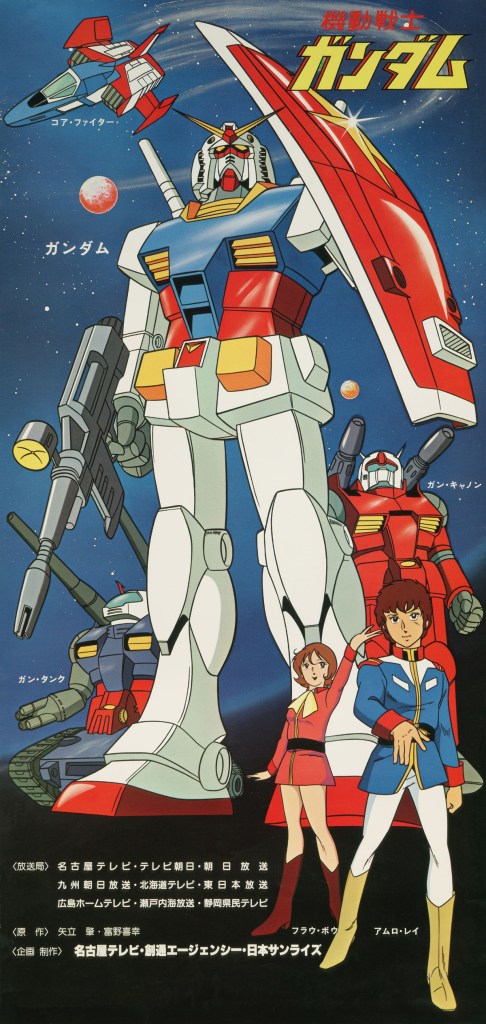
The original Mobile Suit Gundam anime follows the teenage crew of the Earth Federation ship White Base as they’re thrust into the heart of Earth’s war against the Principality of Zeon. In Gundam, war is a spectacle, since the unavoidable conceit of the show is to make boys ooh and ahh over cool robot battles, but aside from the inherent spectacality of any action-based entertainment, Gundam doesn’t try to hide the fact that there is no glory in this fight. Its protagonists start out as civilians, a bunch of kids who end up getting conscripted into a fight they don’t even know all that much about. The show is about their loss of innocence: scenes like the one where Amuro’s mother sobs as she realizes that her son has become desensitized to murder, and where Kai mourns the death of the stowaway spy he had sympathized with, make this very clear.
It’s no coincidence that Gundam comes from the generation of Japanese adults who were kids during World War II. Specific events in the show evoke real-world counterparts, like the dropping of a space colony on Earth that mirrors the use of the atomic bomb. The warring factions have real-life significance, too. Zeon, the fascist allegory and the aggressor in this fictional conflict, is portrayed alongside very obvious Nazi imagery, but is also shown alongside the Rising Sun imagery of imperial Japan, something that startled me when I first noticed it because of how rare it is to see mainstream Japanese media that makes any acknowledgement whatsoever that what Japan did as an empire prior to and during World War II was fascist. And the Earth Federation, despite being the proverbial good side and the one our protagonists identify with, isn’t given any undue honours: they are callous and calculating in their interactions with the crew of the White Base. Gundam sympathizes with the plight of the soldier and the civilian, the pawns in this game rather than the players, and makes this apparent in its portrayal of the national powers involved. The motivations and tactics of these powers are what illustrate the time period and the type of conflicts that inspired them.
The Zeonic Principality’s war against Earth is the result of perceived resource inequity and nationalist-expansionist ideologies. The foundations for this so-called One Year War are expanded upon at length in the 2015 OVA series Mobile Suit Gundam: The Origin, which delves into the feud between Zeon’s noble families and the troubled upbringing of the man who would become Char Aznable. But what’s established in 1979 is that a number of human colonies in space believe they are receiving unfair treatment from Earth, and band together as a Principality to demand independence and to conquer their former homeland and its colonies. It is a direct conflict fought over territory, resources, and nationality, one that our protagonists are thrust into when the crew of the White Base are conscripted onto the front lines.
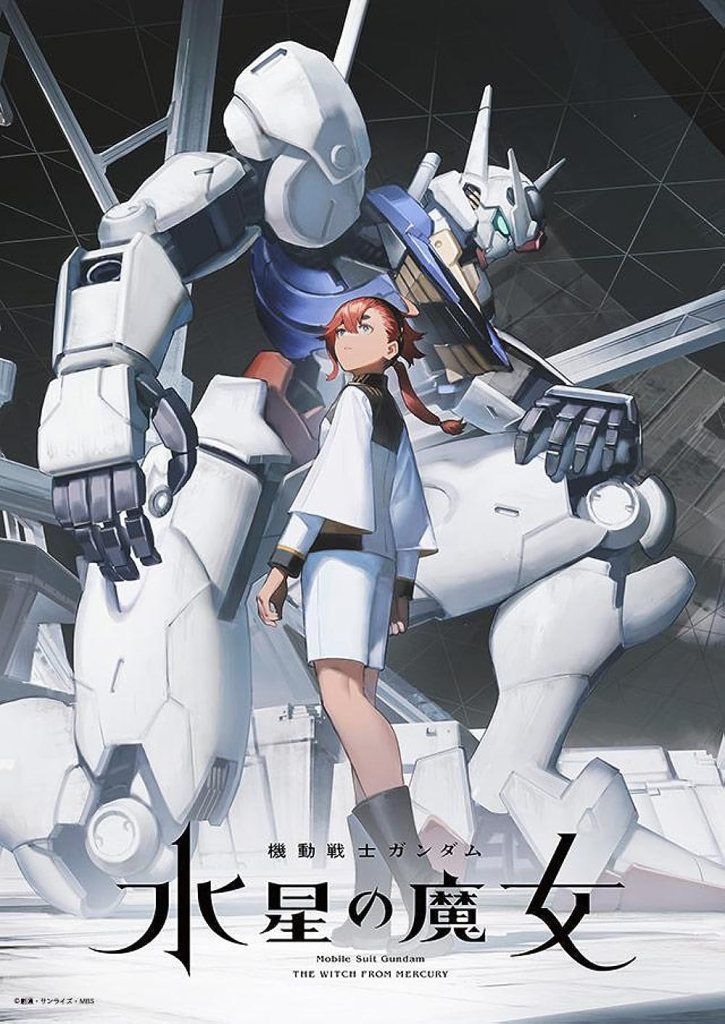
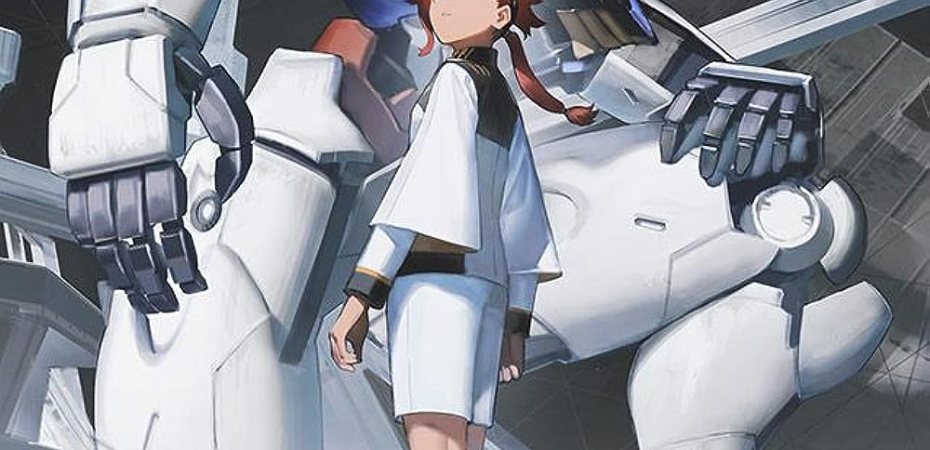
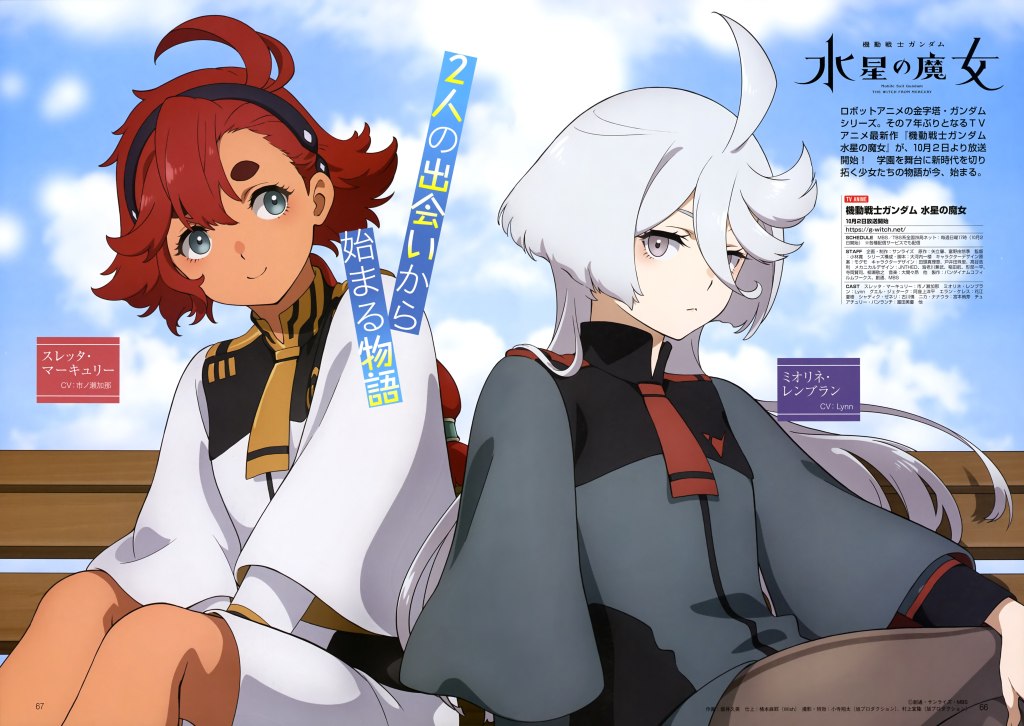
Mobile Suit Gundam: The Witch from Mercury is not on the front lines, and that’s the point. GWitch, as it’s colloquially known, is about business drama, high school, and yuri. Its central premise is an homage to Revolutionary Girl Utena: the show is about a series of high school duels where the winner gets to be the fiancè of an heiress. Like in Utena, it is a girl who ends up winning one of these duels: the titular Mercurian, Suletta Mercury.
GWitch takes place in a different timeline from the original Mobile Suit Gundam series, one that is similar in setting but not actually connected. In the year 122 Ad Stella, Earth has been abandoned in favour of space colonization. Unlike the Spacenoid-Earthnoid relations of ‘79, of which we see glimpses of that contradict the Zeonic rhetoric about Spacenoid inequality, the Spacian-Earthian dynamic in GWitch is very clear: it’s a system of capitalist domination whereby Earth is exploited for resources by companies headquartered in Space. This dynamic between combatants informs not just the resulting conflict, but the whole of GWitch’s setting.
At the high school where GWitch is set, Asticassia, the few Earth-born students face bullying and isolation from the rest of the students. The school dynamic forms the initial focus of the Spacian/Earthian subplot, but increasing references are made to the unrest on Earth, including a news broadcast showing an Earthian revolt being violently put down. The full situation eventually becomes clear: the powerful corporations of the Space colonies, including those of the Benerit group conglomerate that runs the Asticassia school, have been provoking and funding proxy wars on Earth in order to monopolize resource control.
In this new dynamic, when the protagonists are thrust into real war, it’s not because war is now erupting, but because the war that has always existed is now being brought to them by the very people they have subjected to it. GWitch deals with terrorism, and with the political situations that provoke it. This is the 21st century conception of war, where armed conflict is something that happens to poorer people in other places, something that we (in the capitalist, neo-colonial, civilized West or the “Global North”) don’t have to reckon with the consequences of. The Spacian students of Asticassia are the allegory for us; benefitting from the wealth and resources generated for their society by companies like those in the Benerit group without having to reconcile the neocolonial matrix of domination that allows them to generate such wealth: extracting it from Earth, in this case via mining for Permet.
In the Journal of Global South Studies, Godfrey N. Uzoigwe writes that “Essentially, what is broadly called neocolonialism is the nature of relations after independence between European powers and their former colonies of the non-European world.” (Uzoigwe, 62). So granting the specificity of the actual term, its use in this article is a knowing misapplication. But it is the “nature of relations” that make this comparison apt for the allegory GWitch presents. The first usage of neocolonialism described “the practice of granting a sort of independence with the concealed intention of making the liberated country a client-state, and controlling it effectively by means other than political ones.” (Uzoigwe, 62) This articulation of non-political, informal modes of control is where the similarities to Earth in GWitch can be drawn: the relationship between Earth and Space is one of political independence, but economic and military domination. We see the poverty on Earth that results from Spacian companies like the Benerit group firmly controlling the flow of resources, and we see the military occupation that keeps Earthians in line.
The loss of innocence that GWitch’s protagonists go through is not just an outbreak of violence that puts them on the front lines, but a forcible destruction of the curtain that separates them from the conflicts that have been ongoing. The central strife we see for characters like Miorine Rembran and Guel Jeturk, the children of powerful Benerit businessmen, is the realization of the systems that their families maintain and the damage they cause. At the beginning of the show’s second season, Guel Jeturk is held captive on Earth, where he sees the terror that his captors live under. Guel, who just survived a deadly terrorist attack, suddenly has to reckon with the fact that the violence being done to him is a reflection of the violence his family has been inflicting on others. This recognition of the systems at fault is what informs GWitch’s deep sympathy for the Earthian terrorists, even while it understands that terrorism itself is just as destructive. The show manages to walk the fine line between condemning violence and understanding where that violence comes from; we see both the dire circumstances on Earth that led Sophie and Norea to want revenge on Spacians indiscriminately, and the devastating effects of their terrorist attacks on the Asticassia school. The situation’s profound messiness is shown in full, as well as the fact that there are no easy solutions. The last few episodes of the show’s admittedly rushed second season focus pretty heavily on the web of politics that make it so difficult to challenge the status quo, and the problems that come from trying to diffuse a situation that garners violence on both sides. But the fact that the show still acknowledges and highlights the unequal and exploitative capitalist relationship that creates such strife is an impressively political allusion to modern-day neocolonial relationships, particularly those between the Global North and the Middle East, much the same way that Gundam ‘79 alluded directly to the fascist conflicts that inspired it.
Science fiction in general is always a lens through which society assesses itself, and the Mobile Suit Gundam franchise is particularly upfront about the fact that despite all the flashy giant robots, the series is an exploration of war, one which has evolved over time to reflect the way that conflicts and their motivations have changed in a postcolonial, globalized world.
Works Cited:
Uzoigwe, Godfrey N. “Neocolonialism Is Dead: Long Live Neocolonialism.” Journal of Global South Studies, vol. 36, no. 1, 2019, pp. 59–87. JSTOR, https://www.jstor.org/stable/48519445.

 The Vault Publication